


In our previous blog posts (Why page speed optimization is vital; New requirements for Google Page Speed Optimization) we've touched on the importance of page speed optimization. Today, we want to deepen this discussion with a case study that illustrates why optimizing your page speed is crucial for your webshop, and how we can assist you in this endeavor. In today's competitive online landscape, website speed is no longer a luxury, it's a necessity. At Prestachamps, we understand the importance of a fast-loading website for user experience, SEO rankings, and, ultimately, conversions.
Why is Page Speed Optimization Important?
-
1. Improved User Experience: Fast-loading pages create a smooth and browsing experience for your customers. A web page that loads quickly ensures that visitors can navigate through your products and make purchases without frustration. Studies show that even a one-second delay in page load time can lead to significant drops in page views, customer satisfaction, and conversions.
-
2. Enhanced SEO Rankings: Search engines like Google prioritize faster websites in their ranking algorithms. By optimizing your page speed, you’re not only improving user experience but also boosting your visibility on search engine results pages (SERPs). This means more organic traffic coming your way without the extra expenditure on ads.
-
3. Increased Conversion Rates: Speed optimization directly impacts your bottom line. Faster websites have higher conversion rates, meaning more sales. A delay can cost you a significant portion of potential revenue, especially on high-traffic days like Black Friday.
-
4. Reduced Bounce Rates: When a site takes too long to load, users are more likely to abandon the page. Reducing your load time decreases your bounce rate and increases the amount of time visitors spend on your site, which can lead to more interactions and increased sales.
-
5. Mobile Optimization: With the increasing use of mobile devices to access the internet, your webshop must perform well on smartphones and tablets. Mobile users expect quick loading times just as much as desktop users, and optimizing your site’s speed ensures you don’t lose this significant market segment.
How to Optimize Page Speed?
-
Optimize
Images:
Ensure that your images are no larger than they need to be, are in the right file format (JPEG for photos, PNG for graphics with fewer than 16 colors), and are compressed for the web.
-
Leverage
Browser Caching:
This allows visitors' browsers to store website resources on their local computers, so they don’t have to download them again every time they visit your site.
-
Minimize
HTTP Requests:
Reduce the number of elements on your page to decrease the number of HTTP requests required to load the page.
-
Use
a Content Delivery Network (CDN):
CDNs distribute your content across multiple geographically dispersed servers, speeding up the delivery of your website content to users worldwide.
-
Enable
Compression:
Use software applications for file compression, like Gzip, to reduce the size of your CSS, HTML, and JavaScript files.
-
Streamline
CSS and JavaScript:
Minimize the use of blocking JavaScript and CSS in above-the-fold content, ensuring these don't keep the page from loading quickly.
Transitioning from Theory to Practice: A Case Study
Having outlined the critical importance of page speed optimization and provided actionable tips for improving your webshop’s performance, let's pivot to a real-life scenario. This transition from theory to practice will illustrate the tangible benefits of optimizing your page speed through a comprehensive case study. By analyzing the challenges faced, the solutions implemented, and the results achieved, we aim to further underscore the pivotal role that page speed plays in the success of an online business. Stay tuned as we delve into a story of transformation that could very well mirror the journey of your webshop.
The following example illustrates one of many cases we've handled. In this instance, a client approached us with concerns about the bad performance of their webshop. They reported that the slow loading times were leading to a loss of customers and visitors, which negatively impacted their search engine rankings on Google and ultimately resulted in decreased revenue. We stepped in to help, devising and implementing solutions to optimize the site and successfully restore its loading speed.
Our initial step involved conducting an analysis using Google's PageSpeed Insights. After in-depth discussions with the client, we ran the webshop's URL through this tool and received a detailed report highlighting various issues and errors that were contributing to the slow page speed.
Here is an overview of the site's initial state and the key problems that needed addressing:
On Mobile
BEFORE
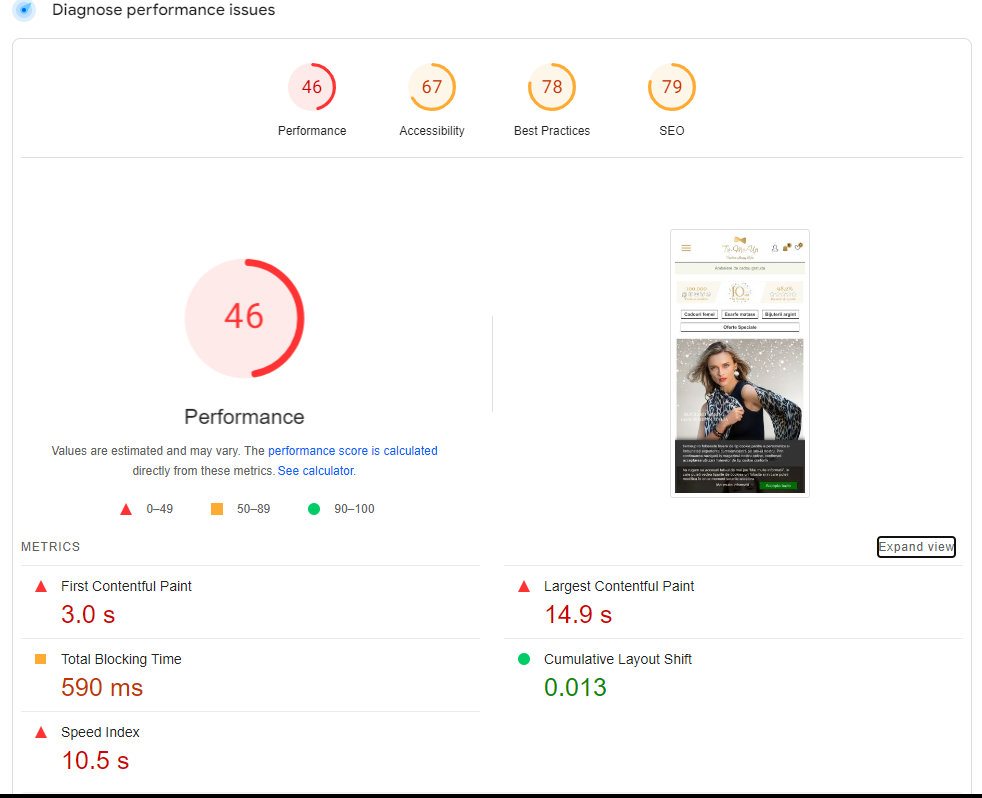
As illustrated in the picture below, the Performance of the site was significantly below expectations. Additionally, the metrics for Accessibility, Best Practices, and SEO were not optimal.
AFTER
Due to the continuously changing nature of the website on mobile devices, some minor issues have arisen, which we can quickly resolve. Overall, the performance metrics are very positive. With our assistance, the page on mobile devices now reloads faster and offers a more convenient experience for customers.

On desktop:
BEFORE
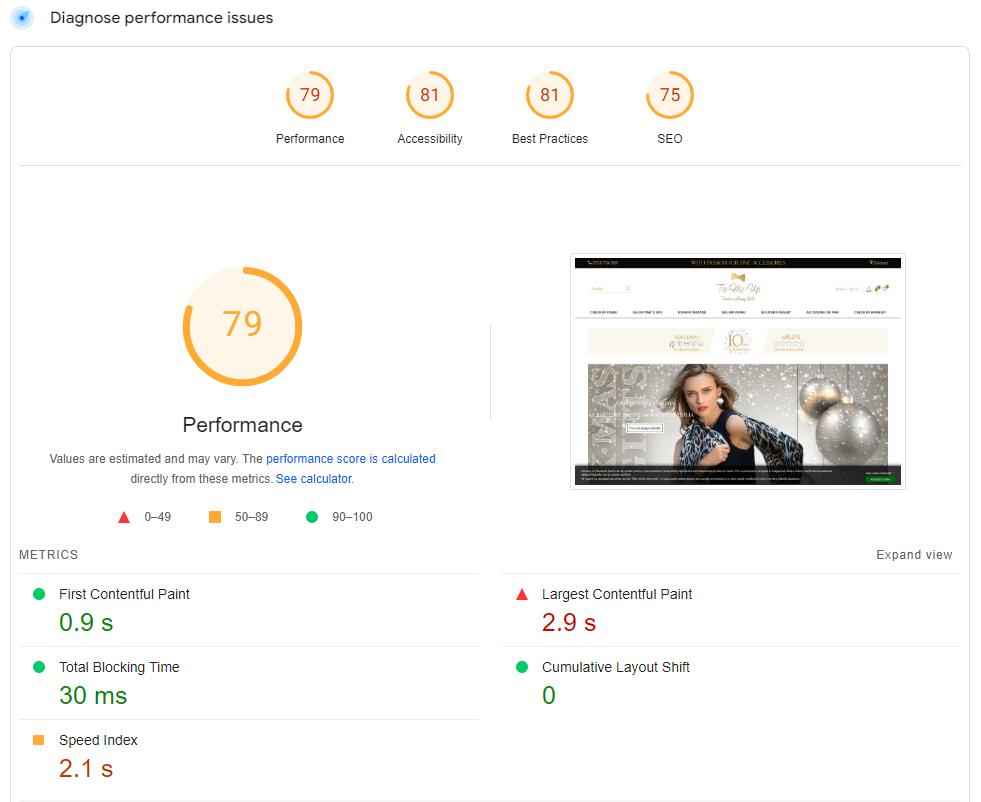
On the desktop version, there were no major problems; however, it was far from perfect, and there were areas that needed improvement. Let's examine what the problems were:
AFTER
On the desktop, we successfully resolved the issues, achieving a high score in page speed performance

- Largest Contentful Paint element
- Reduce JavaScript execution time
- Minimize main-thread work
- Serve images in next-gen formats
- Reduce initial server response time
- Avoid an excessive DOM size
- Eliminate render-blocking resources
- Reduce unused CSS
- Properly size images
- Reduce unused JavaScript
- Image elements do not have [alt] attributes
- Largest Contentful Paint element optimized for faster loading.
- JavaScript execution time reduced for improved performance.
- Main-thread work minimized to enhance responsiveness.
- Images served in next-gen formats for better efficiency.
- Initial server response time reduced for quicker access.
- Excessive DOM size avoided to streamline rendering.
- Render-blocking resources eliminated for smoother operation.
- Unused CSS reduced to optimize loading.
- Images properly sized for better display and performance.
- Unused JavaScript reduced to improve efficiency.
- All image elements now have [alt] attributes for accessibility.
The satisfaction of our customers has made the effort worthwhile. Following our interventions, the webshop now enjoys significantly increased traffic , and revenue has been consistently growing. If you're curious about your website's performance, we encourage you to run your page through Google's PageSpeed Insights Should you encounter any issues, we are fully prepared to assist you in achieving optimal results. Feel free to contact us with confidence, and we will respond promptly.
Improve your site speed in just 2 minutes!
Author

Written by: Evelin-Valéria Székely
About me: With years of experience in the dynamic field of marketing, I specialize in leveraging Google Ads to seamlessly fuse creativity with data-driven insights, ultimately propelling brands to new heights. As a devoted Google Ads specialist, ensuring precise tracking is a non-negotiable priority for me. Staying ahead in the ever-evolving landscape of successful advertising demands continuous learning and adaptation to cutting-edge innovations, like the game-changing feature detailed in this blog. My commitment to staying informed about emerging technologies and features underscores my dedication to delivering optimal results for our clients.